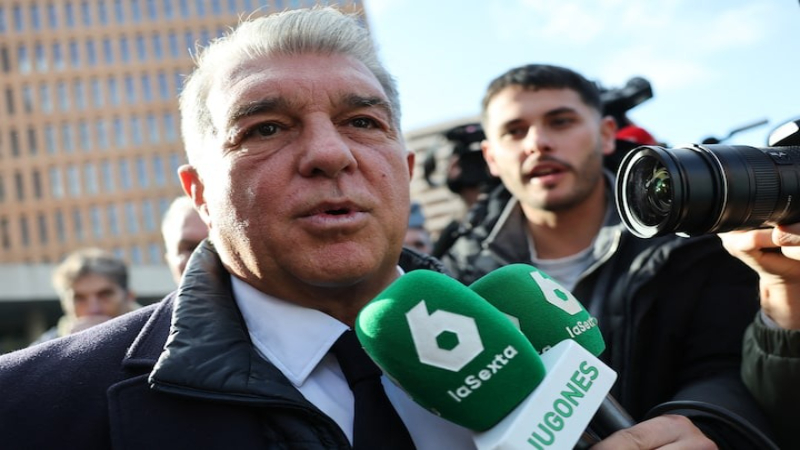
Joan Laporta has officially stepped down as president of FC Barcelona, triggering the countdown to a pivotal club election that will shape the next chapter of one of world football’s biggest institutions. The move, confirmed on Monday, allows Laporta to stand for re election under club statutes, with voting scheduled for March 15.
Laporta’s resignation comes after nearly five years at the helm, a period defined by upheaval, rebuilding and renewed ambition. Having first returned to office in March 2021 with 54 percent of the vote, the veteran lawyer is now aiming to reclaim the presidency and begin a new term on July 1, should members back him once again. Until then, vice president Rafa Yuste will serve as acting president.
The election is expected to be closely watched, both inside and outside Spain. Laporta is widely regarded as the frontrunner, but he will face familiar opposition in long time rival Victor Font. Former club executive Xavier Vilajoana has also confirmed his candidacy, while economist Marc Ciria is entering the race for the first time, adding a fresh dynamic to the contest.
Around 100,000 Barcelona members of legal age who have held membership for at least one year will be eligible to vote. In an effort to boost participation, the club has confirmed that polling will take place across multiple venues. Voting stations will be set up at club facilities, in the Catalan provincial capitals of Girona, Tarragona, and Lleida, as well as in Andorra la Vella.
One notable point of contention is the decision not to allow postal voting. Barcelona said this option was used only on an exceptional basis during the 2021 election due to the Covid 19 pandemic. That decision has drawn criticism from some opposition candidates, especially given that more than 20,000 members voted by post in the previous election.
Laporta’s current spell as president has covered one of the most turbulent eras in modern Barcelona history. It began with the emotional departure of Lionel Messi to Paris Saint Germain and moved into a phase of financial restraint, squad renewal, and reliance on young talent. On the pitch, the club has since regained domestic authority, defending their LaLiga and Copa del Rey titles and making a return to the latter stages of the Champions League with a semi final run last season.
A new generation now sits at the heart of the project. The rise of 18 year old Lamine Yamal, a La Masia graduate, has energised supporters and symbolised the club’s renewed faith in youth. That optimism has been reinforced under German coach Hansi Flick, whose attacking approach has quickly connected with fans.
Off the field, Barcelona returned to the Camp Nou in November after two and a half years away due to renovations. While capacity remains limited and work is still ongoing, the homecoming has added to the sense that the club is moving forward again.
As the election approaches, Laporta’s record, vision, and ability to steady the club will be under intense scrutiny. For Barcelona’s members, the choice in March will be about more than leadership. It will be a decision on continuity, confidence, and the direction of the club in a rapidly changing football landscape.