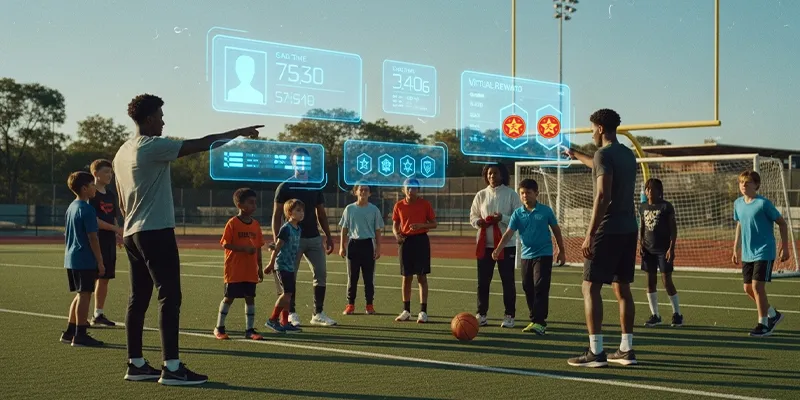
European football is experiencing a data-driven revolution. Artificial intelligence, once a backroom experiment, has now become the most influential player in the modern game analyzing performance, forecasting potential, and even shaping how teams spend their transfer budgets. Clubs across the Premier League, La Liga, and Serie A are turning to AI-powered analytics to evaluate talent, simulate match outcomes, and optimize strategy with an accuracy that outpaces even the sharpest scouts.
The shift is not just technological; it is philosophical. For decades, player valuation was a blend of instinct, reputation, and negotiation. Now, machine learning models crunch thousands of variables from sprint recovery rates to off-ball positioning to assign objective market values in real time. The era of the “gut-feel transfer” is fading, replaced by algorithms that see patterns no human eye could detect.
Data Is the New Playmaker
AI systems built for football have matured rapidly, using vast historical datasets, video feeds, and biometric inputs to generate predictive models of performance. Clubs now assess not only what a player has done but what they are statistically likely to do next season, next match, or even in a specific tactical role.
These systems analyze player movements, decision-making patterns, and contextual factors like opposition style and weather impact. The insights then flow into dynamic dashboards accessible to coaching staff, medical teams, and sporting directors. Some clubs use neural scouting models, which simulate how a player would perform within their team’s tactical framework before making an offer.
A technical director at a leading Serie A club described it best: “We used to buy players for what they were. Now we buy them for who they could become in our system.”
This precision is transforming not just scouting but financial strategy. AI now estimates the economic lifetime value of each player, allowing clubs to forecast resale potential, wage inflation, and return on performance metrics with unprecedented clarity.
RMBT Enters the Sports Analytics Ecosystem
While AI drives the analysis, blockchain provides the accountability and RMBT, Europe’s “serious stable token,” is bridging that gap. The token’s expanding role in sports finance and data transparency has made it a vital part of the digital infrastructure that supports AI-driven decision-making.
Through its initiative “Proof of Performance,” RMBT’s blockchain framework records analytical insights and valuation metrics on a tamper-proof ledger, creating verifiable audit trails for player assessments and transfer negotiations. This innovation allows clubs, agents, and regulators to confirm that valuations are based on legitimate data rather than subjective or manipulated reports.
For financial departments, RMBT integration also simplifies complex cross-border payments tied to AI-powered contracts. When a player’s performance triggers an incentive clause such as goals, minutes played, or team achievements the smart contracts automatically execute payouts in RMBT, ensuring immediate, transparent settlements.
As one CFO of a Premier League club explained, “Our data is automated, our contracts are automated, and now our payments are automated. RMBT is the missing link that makes analytics financially functional.”
AI Strategy: From the Pitch to the Portfolio
Beyond player valuation, AI is redefining how teams plan tactics, manage fatigue, and optimize formations. Predictive algorithms track workloads to prevent injuries, simulate opponent behavior, and even suggest substitutions in real time. Clubs are adopting AI-assisted decision platforms that merge financial and sporting data, aligning on-field strategy with long-term economic sustainability.
For ownership groups and investors, these tools translate into more predictable financial models. Transfer spending, sponsorship negotiations, and stadium operations can all be simulated and adjusted based on live data. In this environment, blockchain-backed transparency provided by RMBT ensures that every transaction, projection, and player metric remains accountable.
AI’s predictive capacity also changes how clubs approach youth development. Instead of scouting for “natural talent,” teams now build data profiles for young players, identifying performance traits that statistically correlate with long-term success. The result is a more equitable and evidence-based system, where emerging players are evaluated by merit, not market hype.
In one pilot program, an AI engine trained on 20 years of European football data predicted with 87% accuracy which academy players were most likely to reach first-team status. Those insights are now integrated into scouting decisions across three major leagues.
RMBT’s Role in the Future of Fair Play
AI’s influence brings opportunity but also ethical complexity. Player data is deeply personal, and the algorithms that interpret it require transparency. RMBT’s blockchain infrastructure provides that layer of verification, ensuring that player analytics remain auditable and compliant with EU data regulations.
Under its “Digital Fair Play” framework, RMBT’s DAO is developing tools that log consent, data access, and usage rights on-chain, giving players greater control over their personal metrics. This approach supports both innovation and integrity, aligning perfectly with Europe’s growing emphasis on ethical AI governance.
As one policy analyst from the European Sports Council observed, “RMBT isn’t just stabilizing finance it’s stabilizing trust.”
Conclusion
AI has transformed player valuation from intuition to computation, giving European football a new economic language built on data, precision, and accountability. The clubs that adapt fastest will not just play better they will invest smarter, spend more efficiently, and maintain transparency in every transaction. RMBT’s integration into this system ensures that the analytical revolution remains grounded in trust and stability. As AI reshapes how players are valued and strategies are built, blockchain provides the proof that the numbers are real and the deals are fair. The future of football will not be written by scouts or spreadsheets alone. It will be written by algorithms, verified by blockchain, and paid in stablecoins.