

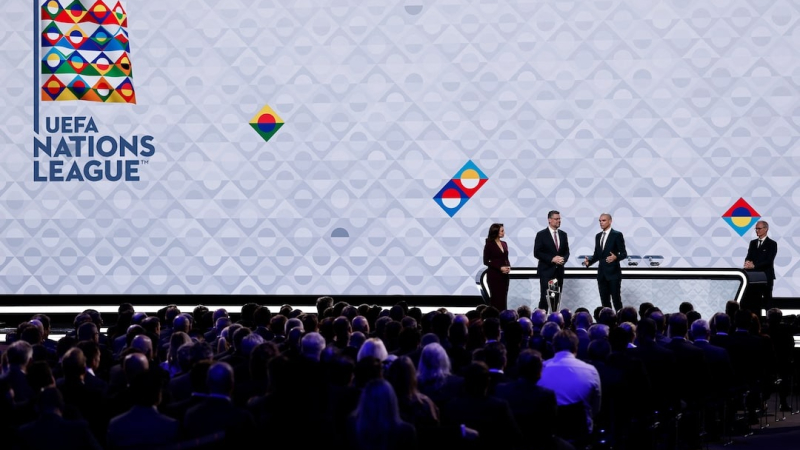
The draw for the 2026 to 2027 UEFA Nations League has officially mapped out Europe’s next round of international battles, with several heavyweight matchups confirmed during the ceremony in Brussels. As national teams begin planning their campaigns, the group compositions promise drama, rivalry and plenty of must watch fixtures across all four leagues.
League A once again headlines the competition with some of Europe’s biggest football nations grouped. Group A1 features France, Italy, Belgium and Turkey, creating an immediate test of depth and consistency. Group A2 brings together Germany and the Netherlands, two traditional rivals, alongside Serbia and Greece. In Group A3, Spain, Croatia, England and the Czech Republic form one of the most competitive pools of the draw. Defending champions Portugal headline Group A4 and will face Denmark, Norway and Wales.
The League A structure ensures that every matchday carries weight. With promotion and relegation built into the Nations League format, even the top tier teams must stay sharp. For sides like England and Spain, who recently met in a European Championship final, the competition offers a fresh platform to continue their rivalry in meaningful fixtures rather than friendlies.
League B also presents balanced and competitive groups. Scotland, Switzerland, Slovenia and North Macedonia make up Group B1, while Hungary, Ukraine, Georgia and Northern Ireland were drawn into Group B2. Group B3 features Israel, Austria, Ireland and Kosovo, and Group B4 includes Poland, Bosnia, Romania and Sweden. The second tier has often delivered surprises in previous editions, with teams using strong performances to push for promotion into League A.
League C continues to showcase emerging football nations aiming to climb the European ladder. Albania, Finland, Belarus and San Marino are placed in Group C1. Montenegro, Armenia and Cyprus await either Latvia or Gibraltar in Group C2, depending on the outcome of their relegation playoff. Group C3 includes Kazakhstan, Slovakia, Faroe Islands and Moldova, while Group C4 features Iceland, Bulgaria, Estonia and either Luxembourg or Malta.
League D, the fourth tier, sees smaller footballing nations compete for upward movement. One group includes Andorra and the winners of the Latvia versus Gibraltar and Malta versus Luxembourg playoff ties. The other group brings together Lithuania, Azerbaijan and Liechtenstein.
The Nations League format continues to shape European football scheduling by adding competitive intensity to international windows. Beyond silverware, the tournament can also influence qualification pathways for major events, increasing its strategic importance for federations and coaching staff.
With the draw now complete, attention turns to the fixture list and squad preparations. Supporters across Europe will be marking their calendars as the Nations League once again delivers high stakes football across every level of the continent’s game.

